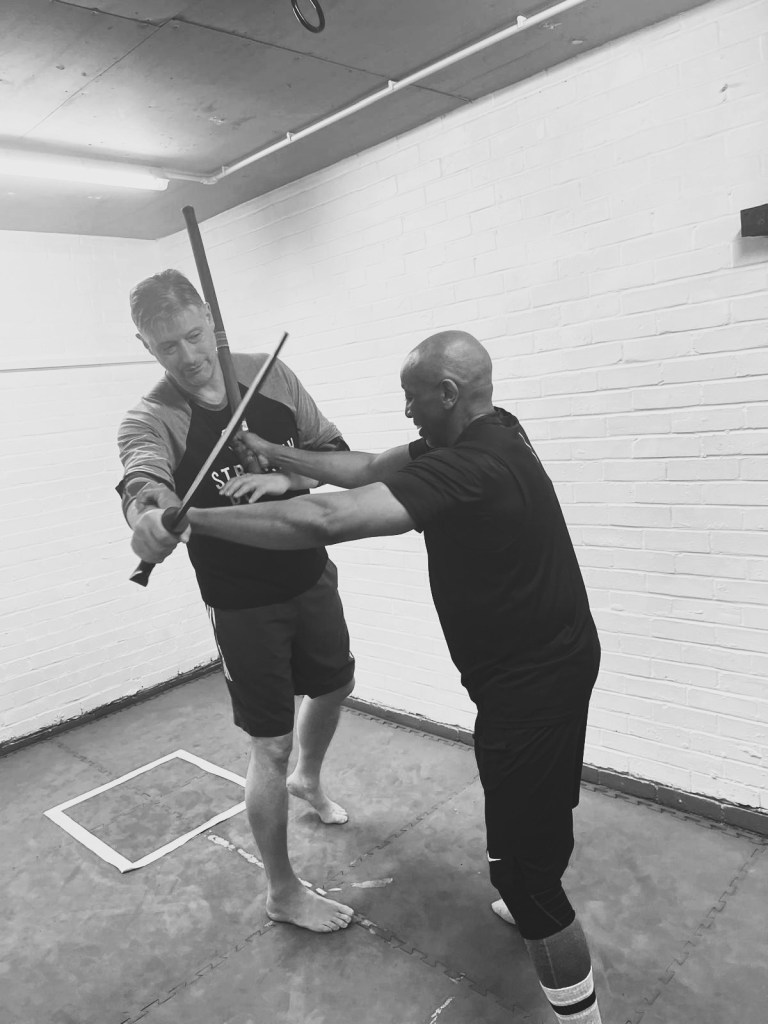
I have been receiving many questions about my KORA sword and dagger class. I would like to clarify a few points to avoid any misunderstanding. Unfortunately, many individuals falsely claim lineage or secret training within the Spanish arts. Due to my ongoing research in Spain, I can confidently say that most of these claims do not withstand scrutiny.
My Experience
My experience with Spanish knife culture and related arts spans nearly four decades. I have visited Spain annually since 1985. That year, I was based in Gibraltar with the British Army for five months. During that time, I trained at a local boxing club. I exchanged boxing coaching for informal knife training with local practitioners. Notably, the Málaga region was historically a hotspot for knife culture. Some of the individuals I trained with had real-world experience rooted in crime or honour-based conflict, including incarceration. While this environment was ethically complex, it produced highly refined and functional skills. This mirrors what has been seen in other documented criminal subcultures, such as the Cape Town Numbers gangs. That material was later researched and systematised by Nigel February under the Piper system. Practical experience is everything in weapons work, which is why Piper is so effective.
Since 1985, I have conducted research trips to Madrid, Seville, Córdoba, Granada, Valencia, and more recently, Barcelona. Despite extensive searching, I never encountered a legitimate training group resembling the one described in Sevillian Steel. Local consensus suggests the author may have misidentified the location. The setting is partially fictionalised because the described training environment and building never existed.
Flamenco and Cultural Crossover
I am deeply involved in Flamenco and spend considerable time within those communities. While not directly related to formal knife systems, there are fascinating cultural crossovers, particularly among older generations. It is common to hear stories. For example, “This is how my grandfather carried a knife.” These stories often include details about how he concealed and deployed it. Some Flamenco dancers still show subtle movement skills that demonstrate this heritage.
From the 1990s onward, I had several introductions in Madrid and Seville. I learned a handful of very informal techniques. These sessions were typically arranged socially and often began with pre-training vermouth discussions.
I strongly advise caution regarding anyone claiming access to secret knife communities. In nearly forty years of involvement, I have met many such claimants. In every case where I tested these claims through sparring with training knives or swords, the results exposed significant exaggeration. A few affluent families claim a “family style” but refuse to demonstrate it to outsiders. Local opinion suggests these traditions have not been tested in real violence for generations. They function more as social mythology than practical systems.
Books and the Baratero Tradition
I have yet to find a truly reliable technical source on the baratero tradition. One notable exception is James Wran, based in Brisbane, who has an upcoming instructional book. I respect his perspective and look forward to reading his work.
James Wran YouTube Interview
Ilustrisimo Sword Training
My second major focus is the sword of Ilustrisimo. I trained privately from around 2018 with an exceptional teacher, who sadly passed away last year. His material, including work with Bancroft, appears on my YouTube channel. His performance in full-contact stick fighting was extraordinary—utterly dominant. His skill level was exceptional.
From approximately 1986 onward, my primary weapons training came through Filipino Martial Arts and Krabi Krabong. I also trained in Western fencing. However, I did not engage deeply with sword work until encountering Ilustrisimo. This experience fundamentally changed my perspective. There is credible evidence of partial Spanish influence within Ilustrisimo, and my ongoing research supports these possible crossovers.
Performance States and Flow
Lastly, I study high-performance flow states, including how they relate to concepts such as Duende. This is the same performance state seen in elite Flamenco dancers, guitarists, and singers—where execution is flawless under pressure. In edged-weapon work, first contact is often decisive, so understanding and accessing this state is critical.
For me, Tatang exemplifies the level of performance I aim to understand and replicate.
Summary
My background includes decades of informal hands-on training across Spain. It also includes private instruction in Ilustrisimo sword and dedicated study of high-performance flow states. I integrate all three through extensive practical application. Under these circumstances, I present the most honest and legitimate synthesis of this material that I can.
Richard Killick
 Killick Off Road Arts